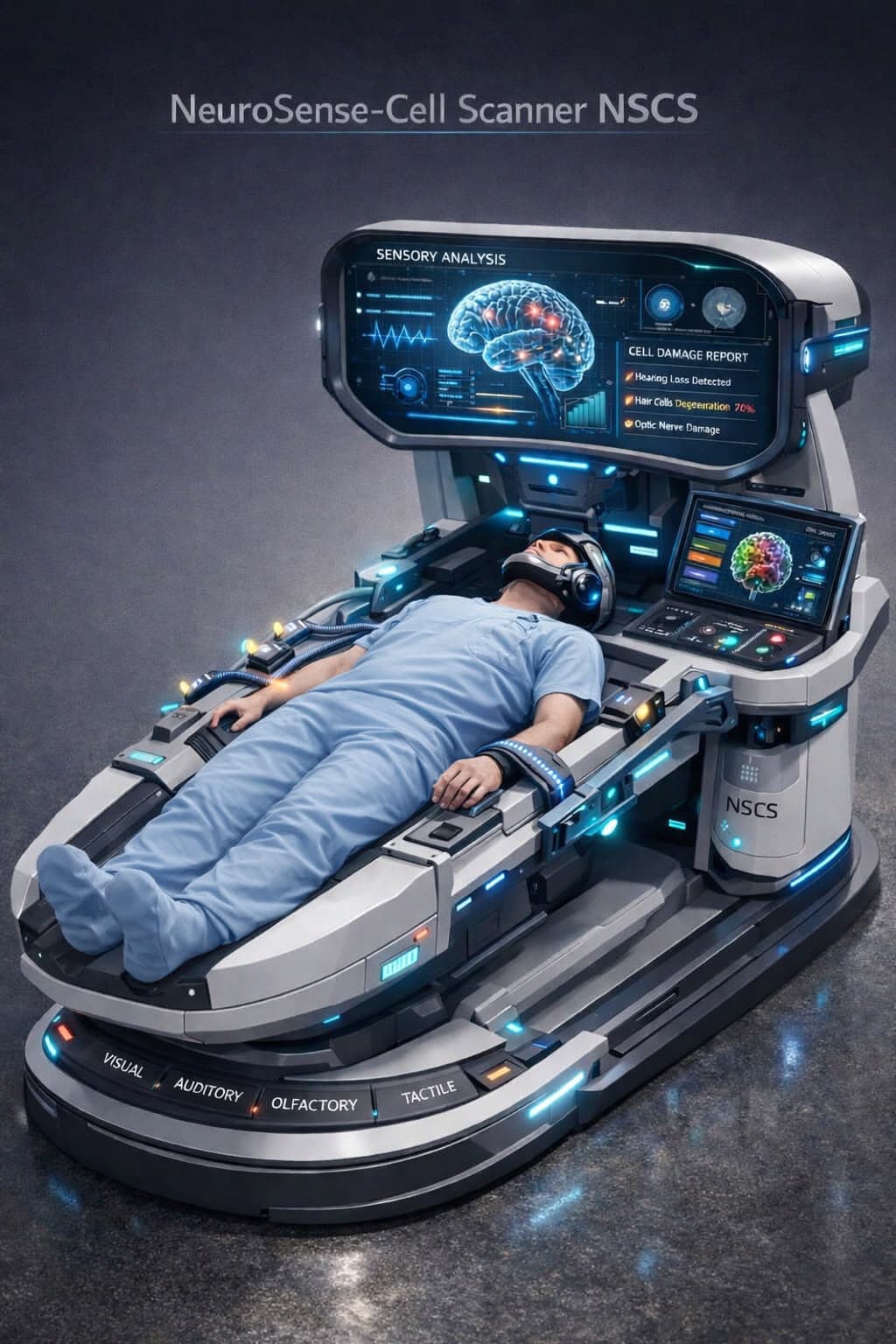
Concept design
- Senses assessed
- 4
- Sight, hearing, smell and touch
- Vital signs measured
- 3
- Blood pressure, blood sugar and heart rate
- Digital report
- 1
- Every finding together in one place
- Needles or incisions
- 0
- The scan is non-invasive by design
Why NSCS
One system for the senses, built for patients who cannot sit or move
Checking the senses usually means several tests, several machines and a patient who can sit and respond. NSCS brings the whole assessment to one comfortable bed.
Traditional assessment
Spread across tests and rooms
- A separate test for each sense, often in different departments
- Many tests need the patient to sit up, move or answer questions
- Imaging shows how tissue looks, not how the nerves respond
- Vital signs are checked on separate equipment
With NSCS
One bed, one session, one report
- Sight, hearing, smell and touch assessed in one system
- The patient lies comfortably on the examination bed the whole time
- AI reads neural response patterns to find the affected sense and where the problem is
- Blood pressure, blood sugar and heart rate measured in the same session
How it works
From first stimulus to full report in four steps
NSCS combines intelligent sensory stimulation, advanced neurosensing and analytical artificial intelligence, with no need for the patient to sit or move.
- 01
Lie down comfortably
The patient rests on a comfortable examination bed with sensitive sensors distributed throughout the body.
- 02
Wear the smart headset
A smart headset monitors brain and nerve activity in real time for the whole session.
- 03
Receive mild stimuli
The device sends gentle visual, auditory, olfactory and tactile stimuli to test each sense.
- 04
AI analyzes the response
Artificial intelligence studies how the nervous system responds and pinpoints the affected sense and the location of the problem.
Inside the NSCS
One bed. One headset. Every sensory pathway.
The patient lies on the examination bed while the smart headset and body sensors follow the nervous system in real time. Select a number to explore each part.
The senses
Four senses, assessed in a single system
Each sense is tested with a mild stimulus while NSCS reads how the nervous system responds, so the affected sense and the location of the problem can be identified precisely.
Visual
Sight
Mild light and pattern stimuli check how the visual pathway responds, from the eye to the brain.
Auditory
Hearing
Soft, controlled tones check how the inner ear and the auditory nerve respond.
Olfactory
Smell
Gentle scents check the response of the olfactory nerve cells and the brain areas that process smell.
Tactile
Touch
Light, controlled touch checks tactile response across the body and helps locate damaged nerves.
Plus vital signs
Three vital signs in the same session
While the senses are tested, NSCS also measures the patient's key vital signs, so they appear in the same report.
- Blood pressure
- Blood sugar
- Heart rate
The report
One comprehensive digital report
Instead of results spread across departments, every NSCS scan ends with a single report that care teams can act on.
- Intact and damaged senses
- Type of affected neurons
- Percentage of cellular damage or inactivity
- Probability of recovery or need for therapeutic intervention
- Blood pressure, blood sugar and heart rate
NSCS digital report
Sensory and nerve assessment
- Patient
- Sample A-0142
- Position
- Lying down
- Stimuli
- 4 of 4 complete
SightVisual
Optic nerve fibers, left side
34%Cell inactivity
ReducedRecovery chance 68%
HearingAuditory
Cochlear hair cells, right ear
70%Cell damage
DamagedIntervention needed
SmellOlfactory
Olfactory receptor neurons
6%Cell inactivity
IntactNo action needed
TouchTactile
Touch receptor nerve fibers
9%Cell inactivity
IntactNo action needed
Vital signs
- Blood pressure
- 118/76mmHg
- Normal range
- Blood sugar
- 96mg/dL
- Normal range
- Heart rate
- 72bpm
- Normal range
Who it is for
Designed for hospital use
NSCS is made for hospital care teams, and especially for patients who are unable to sit or move during a sensory examination.
Neurology departments
See which sense is affected, where the dysfunction is and which type of nerve cells are involved.
Intensive care
Assess patients who cannot sit up or move, without asking them to change position.
Rehabilitation
Use the probability of recovery to decide when therapeutic intervention is needed.
Diabetes care
Check sensation together with blood sugar, blood pressure and heart rate in one session.
Order
Order NSCS for your hospital
Tell us about your hospital and how many units you need. There is no payment on this page: our team gets back to you to confirm everything first.
How ordering works
- 1
Send the order form
Add your hospital details, the department and the number of units you need.
- 2
Send it on WhatsApp
After you submit, tap Send my order on WhatsApp to share every detail with our team in one message.
- 3
We confirm the details
Our team contacts you by WhatsApp or email to confirm your order and the next steps.
Stay informed
Sign up for NSCS updates
Not ready to order yet? Join the list and follow the NeuroSense-Cell Scanner as it develops.
- News as NSCS developsHear about progress on the device and its availability for hospitals.
- Email or WhatsAppGet updates by email, and add your WhatsApp number if you prefer messages there.
- Open to everyoneDoctors, hospitals, researchers, students, patients and families are all welcome.
FAQ
Questions, answered
Everything you need to know about the NeuroSense-Cell Scanner. Still curious? Our team is one message away.
